
The episode covers the headlines. This post is for the people who want the rest of it — the framework, the grant, and the email I could only gesture toward on camera. Consider this the long version.
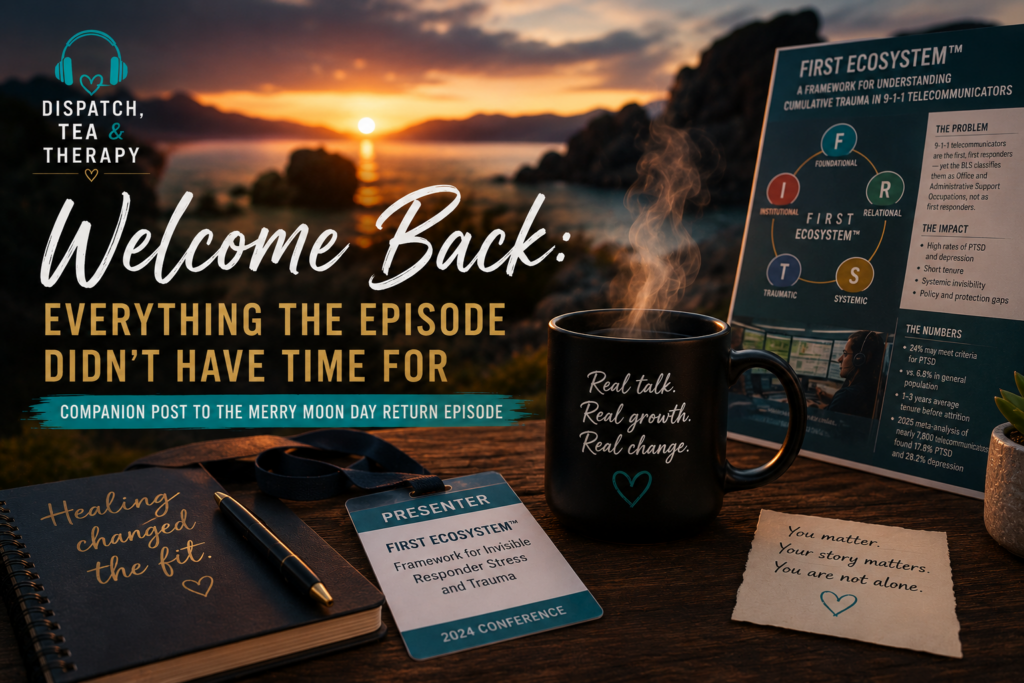
In the episode, I mentioned completing a poster presentation on 9-1-1 and cumulative trauma at a statewide conference. Here’s what that presentation actually was.
The problem. 9-1-1 telecommunicators are the first, first responders — yet the Bureau of Labor Statistics classifies them under Office and Administrative Support Occupations, not as first responders. That structural misclassification limits trauma recognition, access to first-responder-specific support, and eligibility for protections tied to occupational status. There has also been no integrated framework explaining how individual, organizational, and systemic factors interact to produce cumulative trauma in this workforce — which leaves no real model to guide intervention at any level.
For what it’s worth, there is movement on the policy side: the Senate unanimously passed a reclassification bill (S. 725) in 2025. House action is still pending.
The numbers:
- Roughly 24% of dispatchers in studied subgroups may meet criteria for PTSD
- Compared to 6.8% in the general population
- Average tenure before attrition: 1–3 years
- A 2025 meta-analysis of nearly 7,800 telecommunicators found pooled rates of 17.8% PTSD and 28.2% depression
These are not small numbers for a workforce that isn’t even formally classified as first responders.
The FIRST Ecosystem™: What I Actually Presented
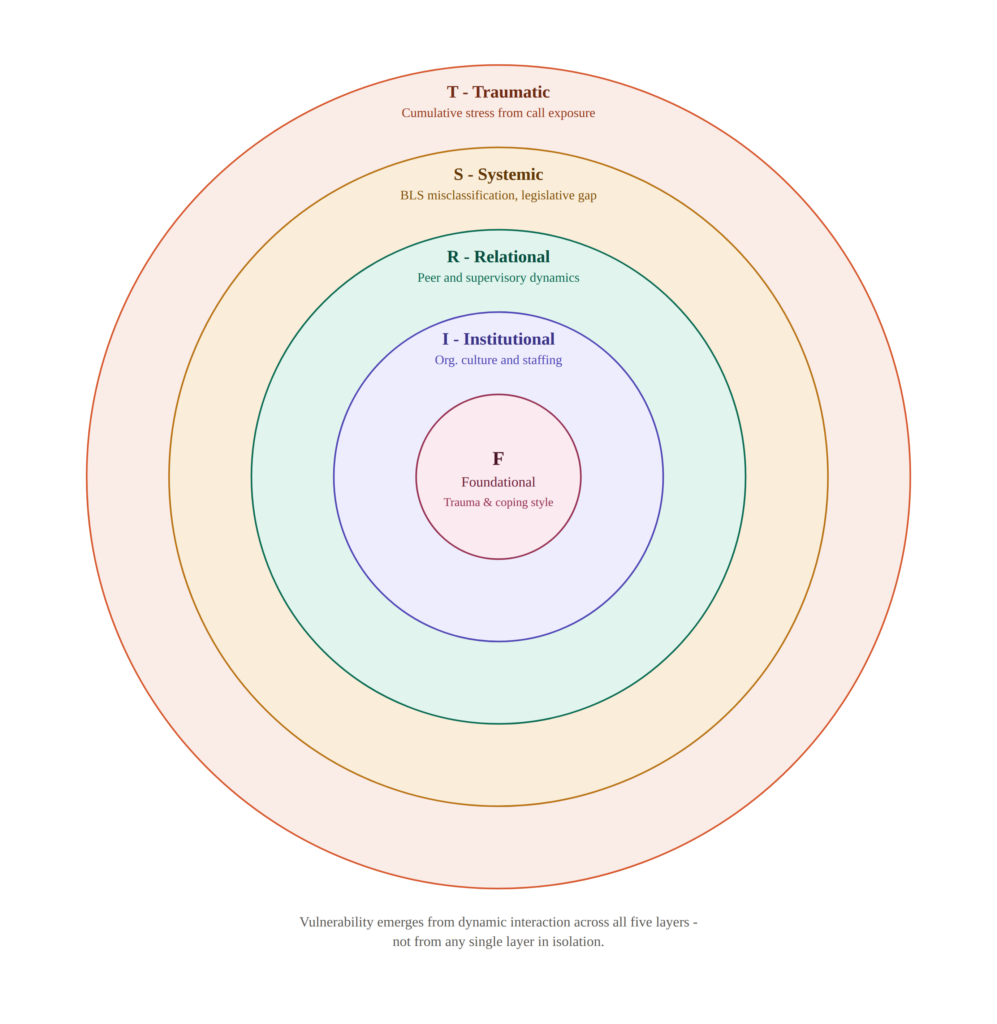
The framework itself — FIRST Ecosystem™, Framework for Invisible Responder Stress and Trauma:
F — Foundational
Pre-employment trauma, attachment patterns, and the coping repertoire a person brings into the job before they ever take a call. This is where the TARP hypothesis lives — Trauma-Adaptation-Realignment Process. The idea, briefly: prior trauma can initially make someone well-suited to 9-1-1 work. The same adaptations that helped them survive something earlier in life can look like strength in a high-stress dispatch environment. But as a person heals and grows — as psychological integration happens — those same adaptations can become a mismatch with the job. Healing changes the fit. That reframes burnout for a lot of people: it isn’t always weakness showing up late. Sometimes it’s health showing up at all.
I — Institutional
Organizational culture, shift structure, understaffing. Power hierarchies that determine whose trauma gets taken seriously and whose doesn’t.
R — Relational
Peer dynamics and supervisory relationships. There’s a real paradox here — a workforce that is tightly interdependent by necessity, and still profoundly isolating. Secondary traumatic stress doesn’t stay contained to one person. It moves relationally, through a team.
S — Systemic
The BLS misclassification. The legislative exclusion. The policy lag mentioned above.
T — Traumatic
Cumulative secondary traumatic stress from high call volume — including moral injury, which shows up when a telecommunicator does everything right and the system still fails the caller in real time.
The core argument of the framework is that vulnerability doesn’t come from any one of these layers in isolation. It emerges from the dynamic interaction across all five, over years. That’s part of why this kind of trauma has been so hard to name, study, and treat — most existing models look at one layer at a time.
Where the research goes next. Three trajectories: validating the ecosystem itself through a cross-sectional study and a new FIRST Scale; testing the TARP hypothesis longitudinally over three years to see how prior trauma shapes retention and symptom trajectories; and piloting an externally delivered telehealth peer support model — specifically external, to sidestep the confidentiality and dual-role problems that come with internal peer support programs.
The ethical piece. If counselors only treat the individual symptom and never name the system producing it, that’s an ethically incomplete response — and it actually reinforces the structural invisibility our profession is supposed to be challenging.
That’s what was presented in Gainesville. The response from researchers and clinicians in the room was genuinely encouraging — enough that the conceptual paper is now actively being written, with publication as the goal.
If you work in 9-1-1 and any of this sounds familiar — the mismatch between who you were when you started and who you are now, the isolation inside a job that’s supposed to be a team, the sense that nobody above you has named what this actually costs — that’s the point of building this. You’re not imagining the accumulation. There’s a framework for it now.
The Grant: Full Story
In the episode, I mentioned a grant proposal I’d been working on. Here’s the complete picture.
The program is a standardized transition care kit for patients being discharged from inpatient psychiatric care into homelessness or unstable housing. The idea came out of repeatedly watching the gap between “discharge” and “actual stability” — patients leaving with a discharge plan on paper and very little else.
The kit itself includes practical, dignity-centered essentials designed to bridge that immediate post-discharge period: hygiene supplies, a way to store medications and discharge paperwork securely, resource information for local services, and items aimed at reducing the immediate chaos of that transition.
Writing the grant took months. Research into comparable programs, cost modeling, needs assessment, drafting and redrafting the proposal itself. It was submitted through a community partnership funding opportunity, requesting more than $60,000 to launch and sustain the program. We expect a decision by late June or early July.
I am genuinely hopeful. But I also want to be honest: even if this particular submission isn’t funded, the work itself doesn’t disappear. A strong, fully-developed proposal puts us in a much better position to refine and resubmit. That’s how grant work actually goes, most of the time.
The Email
I mentioned briefly in the episode that my supervisor sent something to leadership that meant a great deal to me. Here it is, in full, with identifying details removed.
Hello!
I wanted to share a brief update on a grant application that Lucinda, our Peer Specialist, has been leading.
I recently met with Lucinda to finalize the application, and I’m happy to report that it has now been submitted. I’ve attached two documents for your review that reflect the significant effort she put into developing this proposal. Her work thoughtfully addresses a substantial need for our patients, and she invested many hours into shaping a strong and meaningful application.
Lucinda applied through our Community Partnership Fund and expects to hear back regarding funding by late June or early July. As I will no longer be in a full-time role at that point, she may appreciate guidance on next steps should the grant be approved.
I’m incredibly proud of Lucinda’s initiative and dedication. She exemplifies what it means to be a thoughtful steward of [our organization] and a committed partner to our community. Whether or not the grant is funded this cycle, the work she’s done positions us well to refine and resubmit in the future.
I wanted to take a moment to recognize her efforts and share that we truly have some remarkable people doing impactful work here.
Please feel free to reach out if you have any questions.
Great work, Lucinda. Thank you!
I want to say something about why I’m including this in full, rather than just referencing that it happened.
If you’ve spent years in a system where your work was minimized, misrepresented, or simply never acknowledged at any meaningful level — you understand exactly what it means to read something like this. Not because the words themselves are extraordinary. They’re not trying to be. They’re just honest, specific, and sent upward — to people with real organizational authority — without me asking for it.
That’s the difference. Nobody asked this to happen. It happened because the work spoke for itself, and someone was willing to say so, in writing, to the people who matter.
I am letting myself sit in that. I’ve earned it.
A Note on the Rest
The episode also covered a few other things I won’t repeat in full here — the internship moving up, becoming CSI President-Elect, the new roles with WMHCA and Counselors for Social Justice, and getting to see Gabor Maté speak live. Those stood fine on their own in the video and didn’t need expanding for the blog.
This post exists for the things that needed more room: the framework, the grant, and the email. If you’re someone who wants to go deeper than a fifteen-minute video allows — this is what that looks like.
More on the FIRST Ecosystem™ as the paper develops. More on the grant as soon as we hear back.
Let’s keep building. Let’s keep sipping. Let’s keep telling the truth.
💛 Lucinda,
Dispatch, Tea & Therapy