
If you just watched Episode 1 — you already have the story. I am not going to retell it here.
What I want to do in this space is name what was happening underneath it. The clinical framing. The patterns that make what I described recognizable — not just as my experience, but as something that happens in systems. Specifically in 9-1-1.
Because if any of what I described felt familiar, I want you to have language for it.
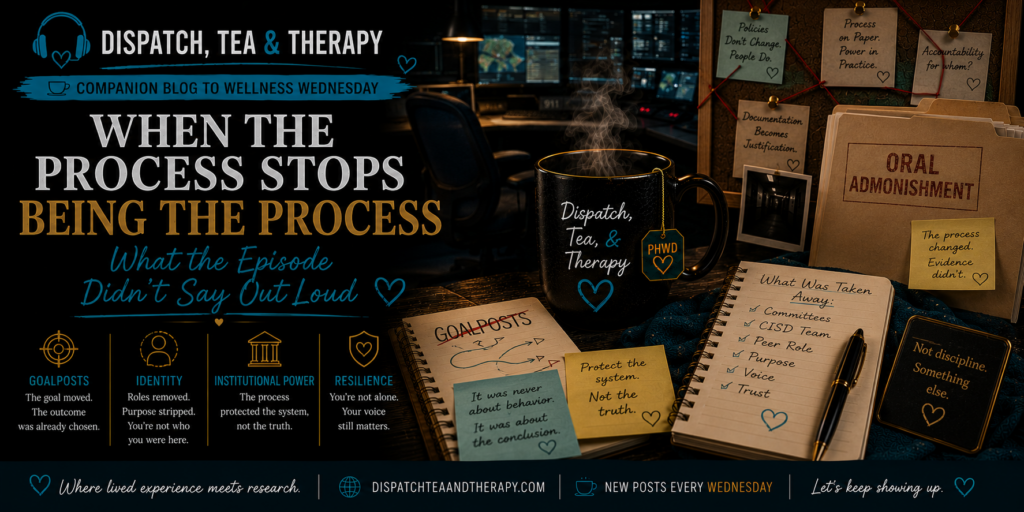
Goalpost-Moving: What It Is and Why It Matters
Identity Erosion: The Part That Goes Unnamed
I talked on camera about being removed from my committees and from the CISD team — the Critical Incident Stress Debrief team, the function that exists specifically to support the humans doing this work. I was a certified peer support specialist. I was credentialed for exactly that role.
And I said: that is not discipline. That is something else.
What it is, clinically, is identity erosion.
When systems remove people from the roles that reflect their strengths — not because of performance failure in those roles, but as a consequence of a disciplinary process — they are not just changing a job description. They are making a statement about who that person is allowed to be at work. They are severing the connection between the person and the work that gives the job meaning.
For people in 9-1-1, where the work itself is often what makes the environment survivable — where the peer support role, the training role, the committee work is what keeps a person engaged in a system that is otherwise grinding them down — that severance has a cost that goes far beyond the job title change. It removes the thing that made staying worth it.
From the outside, it can look like burnout. Like disengagement. Like someone who chose to step back.
Sometimes it is not a choice. Sometimes it is what happens when a system removes the parts of the work that made you want to show up.
FIRST ECOSYSTEM™ SECTION
The FIRST Ecosystem™: Where This Lives The FIRST Ecosystem™ — the research framework I have been building for cumulative trauma in 911 telecommunicators — has a layer called I: Institutional. Organizational culture. Shift structure. Understaffing. And critically: power hierarchies that determine whose trauma gets legitimized — and whose doesn’t. What I described in Episode 1 is the I layer in practice. A process that existed to produce a predetermined outcome. A disciplinary structure applied with enough institutional authority that questioning it felt impossible from the inside. A power dynamic that made the evidence almost irrelevant — because the people with the authority to stop the process when the evidence didn’t hold chose not to. That is not an individual failure. That is an institutional one. And it is one of the reasons the FIRST Ecosystem exists as a research framework — because treating cumulative trauma in 9-1-1 as an individual problem, when the sources of that trauma are so often structural, is not just incomplete. It is ethically insufficient. |
If This Sounds Familiar...
If you are in 9-1-1 and any part of what I described resonated — the process that changed its own terms, the evidence that didn’t seem to matter, the removal from roles that made the work meaningful — I want you to know a few things.
First: you are not imagining it. Processes that function this way are recognizable. They have names. Researchers study them. What you are experiencing has a shape that can be described and documented.
Second: your reaction to it is not the problem. Hypervigilance, distrust, disengagement, the sense that something is deeply wrong even when you cannot prove it in a meeting — those are rational responses to an irrational environment. Your nervous system is doing its job.
Third: documentation is your friend. Not in a paranoid way — in a practical way. Know what is in your personnel file. Keep your own record of what happens and when. Not because you have done anything wrong, but because institutional memory is selective and yours does not have to be.
Episode 2 goes further into what that documentation can reveal — and what you can do with it. I will see you Wednesday.
One More Thing ...
I said on camera that I am telling this story not from a wound but because it matters. I want to say that again here, in writing, because it’s important.
I am not processing this in real time. I am reporting it from the other side of it — from a place where I am genuinely, not only doing well, but truly thriving. Where I have a job that sees me, research that matters, and enough distance from what happened to talk about it clearly.
The reason I am talking about it at all is because I know that some of you are still inside it. Still in that chair. Still trying to figure out whether what you are experiencing is real, whether it has a name, whether anyone outside that building would understand it.
It is real. It has a name. And I am building the research to prove it.
I hope you’ll stay with me on the journey.
💛
Lucinda
Dispatch, Tea & Therapy
Watch the companion episode: “When the Process Stops Being the Process” on the Dispatch, Tea & Therapy YouTube channel.
The FIRST Ecosystem™ is © Lucinda Black, 2026. All rights reserved.