
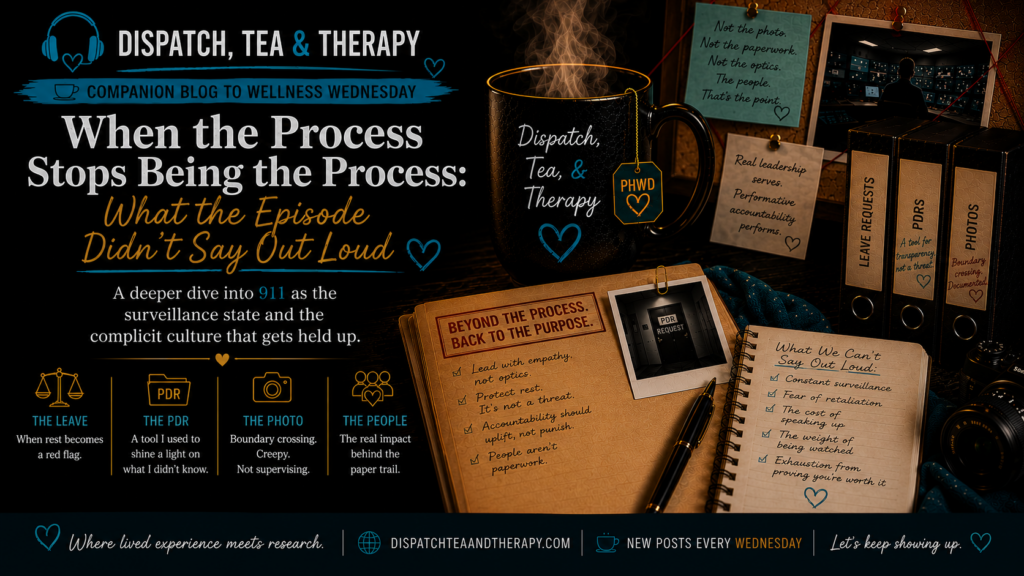
9-1-1 and the Surveillance State: What the Episode Didn’t Say Out Loud
If you just watched today’s YouTube episode — welcome to the part that wouldn’t fit on camera.
The video told you the story. The choice a tenured colleague made instead of simply getting my attention. An institution that accepted what came from that choice without asking whether the method was appropriate. HR contacting me during mental health leave — through my personal network — for meetings that were being rescheduled anyway. And a public disclosure request that revealed all of it after I was already gone.
This page carries what comes after the story. The framework that explains why it happens. The research that names what it costs. And — most importantly — what you can do if you are still in that room right now.
First: What I Own
I said this on camera and I want it in writing too.
I was on duty supervising a trainee. I was distracted — doing something non-work related, not paying attention to the person I was supposed to be supervising. That was wrong. I am not disputing it. I know what the right response looks like because I have delivered it myself as a supervisor. I was not doing it.
I own that. Fully. Everything that follows is about the response — not about whether I deserved accountability. I did. The question is what kind, through what method, and with what degree of proportionality.
The FIRST Ecosystem: Where This Story Lives
In the episode I introduced the FIRST Ecosystem on camera for the first time — Framework for Invisible Responder Stress and Trauma. Five layers: Foundational, Institutional, Relational, Systemic, Traumatic. All five interacting simultaneously. Vulnerability emerging from the accumulation across all of them, not from any single factor in isolation.
What I described in Episode 2 maps precisely onto two of those layers.
The I Layer — Institutional.
Organizational culture, power structures, and — critically — the gap between what institutions say they value and what they actually accept. We were always told: supervise in the moment. If you see something, address it then. That was the standard we held people to. We were also consistently reminded that personal devices used in ways that create documentation are publicly disclosable. Both of those expectations existed. Neither was applied when it mattered.
The photograph moved up the chain. The operations manager knew. HR knew. It was accepted as evidence without anyone apparently asking: was this method appropriate? Does this align with our own stated policies? That acceptance is not a policy failure. It is a cultural statement. It says: this is acceptable here. And cultural statements made at the institutional level echo through every person inside that system — whether or not they can name exactly what changed.
The R Layer — Relational.
Peer dynamics and supervisory relationships. The way trust moves through a workforce — and the way betrayal does. The person who took that photograph was not a confused new employee. This was a tenured dispatcher, a long-serving union leader, someone who knew every protocol in that building. Sitting right next to me. Every option available to get my attention. They chose a personal device and a photograph instead.
That is a relational choice. And in a workforce where people depend on each other in moments of genuine crisis — where the person next to you may be the one talking you through something that will stay with you for years — that kind of choice has a cost that does not resolve when the shift ends. You cannot unknow that it happened. The room does not feel the same afterward.
Research on organizational climate consistently shows that perceived surveillance — even when informal and undisclosed — increases stress, reduces psychological safety, and contributes to the kind of withdrawal that precedes attrition. This is not paranoia. This is a documented, measurable outcome of environments where being watched by colleagues is accepted without scrutiny.
Both layers. Simultaneously. That is how cumulative trauma builds in 9-1-1 — not from one bad incident, but from the interaction of institutional culture and relational betrayal operating at the same time, in the same room.
What Happened During Mental Health Leave
I want to give this its own section because it deserves more space than the video could hold.
When I went on mental health leave, there were two pending inquiries. Not one. Two. Fact-finding had not yet occurred for either. I had not been in a fact-finding meeting. I had not had the opportunity to present my side of the record.
HR contacted me during that leave. To notify me that fact-finding meetings were being rescheduled. When I did not respond as quickly as they wanted, they escalated — reaching out to people in my personal life to relay messages to me and ensure I had acknowledged the notifications.
The meetings were always going to be rescheduled. They could have waited. The information was administrative. It was not urgent. The urgency was manufactured.
HR knew I was on mental health leave. They contacted me anyway. They contacted my personal network when I did not respond fast enough.
I want to be precise about what that is. HR exists, in part, to protect employees from exactly this kind of pressure. When HR becomes the source of that pressure instead — when the function designed to support employee wellbeing reaches into your personal relationships during a mental health absence to deliver messages about disciplinary proceedings — the institution has revealed something important about itself.
When an institution contacts an employee through their personal network during a mental health absence, it signals that your leave is not a protected space. That the organization will find ways to maintain pressure regardless of your documented status. For a nervous system already operating in a state of chronic threat — already carrying the weight of a prior disciplinary action, a covert photograph, inquiries that kept moving forward — that signal does not land as administrative. It lands as: there is no safe place here.
I took the full twelve weeks. And I did not go back.
WHY HELP-SEEKING FAILS
Why This Matters Beyond My Story
This is not a story about one bad workplace. This is a case study in what institutional harm looks like when it operates at every level of a chain simultaneously.
When nothing is safe — not the people around you, not your direct supervisor, not HR, not the director — trust erodes completely. And when trust erodes in 9-1-1, help-seeking becomes nearly impossible.
Because help-seeking requires believing that reaching out will not be used against you. It requires a baseline of psychological safety that says: if I am vulnerable here, I will not be punished for it. When an environment has shown you clearly and repeatedly that vulnerability gets deflected or weaponized — when the director responds to a vulnerable email with a reference to your professional feedback and ends with “take care” — you stop reaching out. You absorb more. You stay in pain longer than you should.
Research on help-seeking in high-stress occupations consistently shows that perceived organizational support and psychological safety are among the strongest predictors of whether workers ask for help. When workers do not believe their workplace is safe, they self-manage. They white-knuckle it. And the cumulative cost of that self-management is exactly what the literature on secondary traumatic stress and moral injury documents in 9-1-1 workers at alarming rates.
This is not a willpower problem. This is not a resilience problem. This is a systems problem. And the FIRST Ecosystem exists to name it as one — so that the response can match the actual source of the harm.
Not the individual who could not cope. The system that made coping impossible.
PDR HOW-TO
The PDR: What It Is, How to Use It, Why It Matters
I found out about the photograph through a Public Disclosure Request — submitted after I was no longer working there. Here is what a PDR is and how to use one.
A PDR (called a Public Records Request, FOIA request, or Personnel File Request depending on your state) is a legal mechanism that allows you to request documentation held about you by your employer. This includes:
Your personnel file. Emails in which you are named or discussed. Documentation from formal investigations or inquiries. Incident reports and records. Evidence submitted in any formal process. Photographs or other materials retained in connection with your employment.
You do not have to wait until you leave. In most jurisdictions you can request your own documentation while still employed. Your employer is typically required to respond within a set timeframe — in Washington State, five business days to acknowledge the request, with records to follow.
How to start: n my case, the process was straightforward — my employer had their own online portal specifically for public disclosure requests. It was easy to find, easy to use, and worth starting there before assuming the process will be complicated. Check your employer’s website first. You may be surprised how accessible it already is.
Search your state name plus “public records request” or “personnel file request” to find the specific process in your jurisdiction. Submit in writing. Keep a copy of everything you send and receive. If you are a union member, your union representative may be able to assist. If not, legal aid organizations in many areas can provide guidance at no cost.
Why this matters: Knowledge of what is in your personnel file is a form of self-advocacy. Workers who understand their documentation are better positioned to respond to decisions made about them, to grieve outcomes through appropriate channels, and to protect themselves when processes go sideways. There is a meaningful psychological difference between not knowing what exists and knowing — even when the content is difficult. The latter, however painful, restores a degree of agency.
I am not a lawyer. Find out what your specific rights are in your state. But find out. Because if there is documentation being created about you — in any form — you have the right to know what it says.
If You Are Still In That Room
Some things you can do right now:
Document your own work. Keep a personal log — not on work devices — of what you do, when, and who is present. Not because you have done anything wrong. Because documentation is a tool that belongs to everyone, not only to institutions.
Know your file. Submit a public records request for your personnel documentation. Read it. Know what is in it before anyone else uses it against you.
Know your union rights, if applicable. Your contract likely includes provisions about how investigations must be conducted, what evidence can be used, and what your rights are during formal processes. Read it. Ask your rep.
Know your leave rights. If you go on medical or mental health leave, understand what contact your employer is and is not permitted to initiate during that leave. In many jurisdictions this is regulated. Find out the rules in your state before you need them.
And if you find yourself in a place where the systems meant to protect you have become the systems applying pressure to you — trust that recognition. Name it. Naming it clearly is the beginning of deciding what to do next.
You deserve a workplace that functions the way it says it does. That is not a radical position. It is a basic one.
CLOSING
See You Thursday
Poetry Thursday this week is Maya Angelou.
Still I Rise.
After this week — it is the only poem that makes sense.
💛
Lucinda
Dispatch, Tea & Therapy
Watch the companion episode: “9-1-1 and the Surveillance State — Episode 2” on the Dispatch, Tea & Therapy YouTube channel.
The FIRST Ecosystem™ is © Lucinda Black, 2026. All rights reserved.